
How Narcolepsy Is Diagnosed: The Tests, the Criteria, and What Comes Next
Key Takeaways
- Obtaining a narcolepsy diagnosis is often a lengthy process that includes a clinical evaluation, an overnight polysomnogram, and a daytime nap study.
- The initial clinical evaluation involves a medical history, symptom review, sleep diaries, and questionnaires like the Epworth Sleepiness Scale.
- Overnight polysomnography monitors brain waves, breathing, and heart rate to assess sleep quality and rule out other conditions like sleep apnea.
- The daytime nap study (Multiple Sleep Latency Test) measures how quickly you fall asleep and enter REM sleep during the day.
It took Alyssa Ostroff 12 years to obtain a narcolepsy diagnosis. From the moment she began experiencing symptoms of excessive daytime sleepiness (also known as hypersomnia) at age 17, her life became an endless cycle of caffeine, weight gain, and dismissive attitudes from her doctors:
“I gained weight because I was self-medicating [with caffeine and a poor diet], because there was something wrong, and no doctor was willing to look past my weight to help me,” she says.
Over the years, Ostroff says she was tested three times for sleep apnea, with doctors determining that wasn’t the issue. Eventually, she lost weight and advocated for herself until she underwent yet another sleep study that provided her with the elusive narcolepsy diagnosis.
Unfortunately, Ostroff’s delay in receiving a narcolepsy diagnosis is common. To help you reach answers sooner, this article will answer the question “How is narcolepsy diagnosed?” by covering the necessary steps, from the first appointment through sleep testing.
How is narcolepsy diagnosed?
Narcolepsy is typically diagnosed through a clinical evaluation, an overnight sleep study, and a daytime nap study the following day.
-
Clinical evaluation: The first meeting with a healthcare provider will likely include a discussion about your symptoms and written questionnaires.
-
Overnight sleep study: A polysomnogram (PSG) records your brain waves, heart rate, and breathing as you sleep.
-
A daytime nap study: Usually conducted the day after the PSG, a multiple sleep latency test (MSLT) measures how quickly you fall asleep in a quiet environment during the day.
-
Additional testing, if necessary: Depending on your case, your healthcare provider may wish to perform additional testing to determine your type of narcolepsy.
What happens at the first appointment?
At the first appointment, your healthcare provider will assess your symptoms through a medical history, physical examination, and possibly a sleepiness questionnaire.
Initial appointments typically take place either at a primary care physician’s office or a sleep medicine specialist’s office.
“The clinician will ask when the patient started experiencing excessive daytime sleepiness,” explains Scott Nass, MD, a family medicine physician at SwiftCareMD. The clinician will then ask additional questions about your frequency of unintentionally falling asleep throughout the day, and “whether the excessive daytime sleepiness is impacting work, school, driving, or other aspects of daily life.”
Dr. Nass says the healthcare provider will likely ask about other symptoms associated with narcolepsy. These symptoms can include:
-
Cataplexy: Muscle weakness triggered by strong emotions like laughter or fear
-
Sleep paralysis: The inability to move or speak when waking up or falling asleep
-
Vivid hallucinations: Intense, dreamlike experiences when waking up or falling asleep
-
Fragmented nighttime sleep: Awakening from sleep multiple times nightly
During this initial visit, the healthcare provider may also have you complete a screening questionnaire like the Epworth Sleepiness Scale (ESS), which assesses your level of daytime sleepiness. While the ESS can help confirm excessive daytime sleepiness, the questionnaire cannot diagnose narcolepsy alone because, Dr. Nass notes, it doesn’t provide the reasons behind your hypersomnia.
In addition to the ESS, your healthcare provider may suggest completing a sleep diary, which is a written record of your sleep habits, sleep quality, and lifestyle factors (including medicines, alcohol, and caffeinated drinks). “It will indicate if the patient has sufficient hours of restful sleep and if their fatigue follows a specific pattern,” says Dr. Nass.
Another option for tracking sleep habits and quality is using actigraphy. This test uses a motion detector worn like a wristwatch to assess a patient’s sleep-wakefulness activity over one to two weeks.
Since “no definitive diagnosis” is typically made at this first appointment, says Dr. Nass, the next steps will depend on the information collected during the visit. The primary care provider may then refer the patient to a sleep specialist, who will typically order an overnight sleep study in a lab followed the next morning by a daytime nap test (MSLT).
Which sleep studies diagnose narcolepsy?
A narcolepsy test usually consists of at least two sleep studies: overnight polysomnography (PSG) and the multiple sleep latency test (MSLT).
Overnight polysomnography (PSG)
Overnight polysomnography monitors your body’s activity while you sleep. The study records your brain waves, heart rate, breathing, and oxygen levels in your blood. It also tracks your eye, leg, and arm movements. When it comes to what a sleep study can diagnose, PSG alone cannot confirm narcolepsy. But it can show the amount and quality of sleep you are getting by noting your fragmented nighttime sleep.
PSG also plays a vital role in how narcolepsy is diagnosed by helping to rule out other potential diagnoses. According to an article in the Handbook of Clinical Neurology, polysomnography is considered the gold standard for diagnosing sleep-related breathing disorders, including sleep apnea and sleep-related hypoventilation/hypoxia (shallow breathing).
Polysomnography is typically conducted — you guessed it, overnight — in a sleep lab. Although details vary by sleep center, the American Academy of Sleep Medicine (AASM) says patients can expect to arrive in the evening, sleep in a provided bed with attached wires to different parts of your body (head, chin, chest, and legs).
Multiple sleep latency test (MSLT)
The multiple sleep latency test (MSLT) is a full-day test in a sleep lab consisting of five scheduled naps. The test measures how quickly you fall asleep during the day in a quiet environment and how soon you enter rapid-eye movement (REM) sleep. REM sleep is one of the four stages of sleep and a period of high brain activity when dreams occur.
Where home sleep testing fits
If you’re wondering how the sleep lab vs. home sleep test debate fits into this discussion, you’re in the right place, because it’s a little confusing.
According to a 2019 article in Sleep Medicine, the most commonly used home sleep tests cannot diagnose narcolepsy because most portable units lack electroencephalogram (EEG) recording capabilities. EEG, which tests for abnormalities in your brain waves and is available through PSG, is essential for a narcolepsy diagnosis.
Even though a home sleep test cannot diagnose narcolepsy on its own, it can still be helpful. A home sleep test can either identify or rule out sleep apnea, a common cause of excessive daytime sleepiness.
How do you prepare for a narcolepsy sleep study?
Preparation for a narcolepsy sleep study — which will likely include both overnight PSG followed by MSLT the next day — may begin a few weeks before the date of your sleep study.
Below are some practical steps to prepare, as recommended by the American Academy of Sleep Medicine (AASM):
A few weeks before testing:
-
Keep a consistent sleep schedule for about 2 weeks before testing; your doctor may encourage you to keep a sleep diary so they can get a better idea of your sleep patterns.
-
Discuss your medications with your healthcare provider. Some medications can alter your test results, so your doctor may temporarily discontinue certain meds before your sleep studies. Medications that affect alertness, sedation, or REM sleep (like antidepressants) are sometimes tapered and stopped at least 2 weeks before testing, sometimes longer, so this planning needs to ideally happen several weeks in advance.
The day of your overnight sleep study:
-
Follow your routine as much as possible
-
Avoid napping
-
Avoid caffeine
-
Avoid alcohol or other sedatives unless otherwise prescribed by your doctor
The morning after your overnight PSG, before the MSLT begins:
-
Even if you’ve discontinued certain medications per your doctor’s advice, you may have to take a drug test the morning of the MSLT to ensure accurate results.
How is type 1 narcolepsy diagnosed differently from type 2?
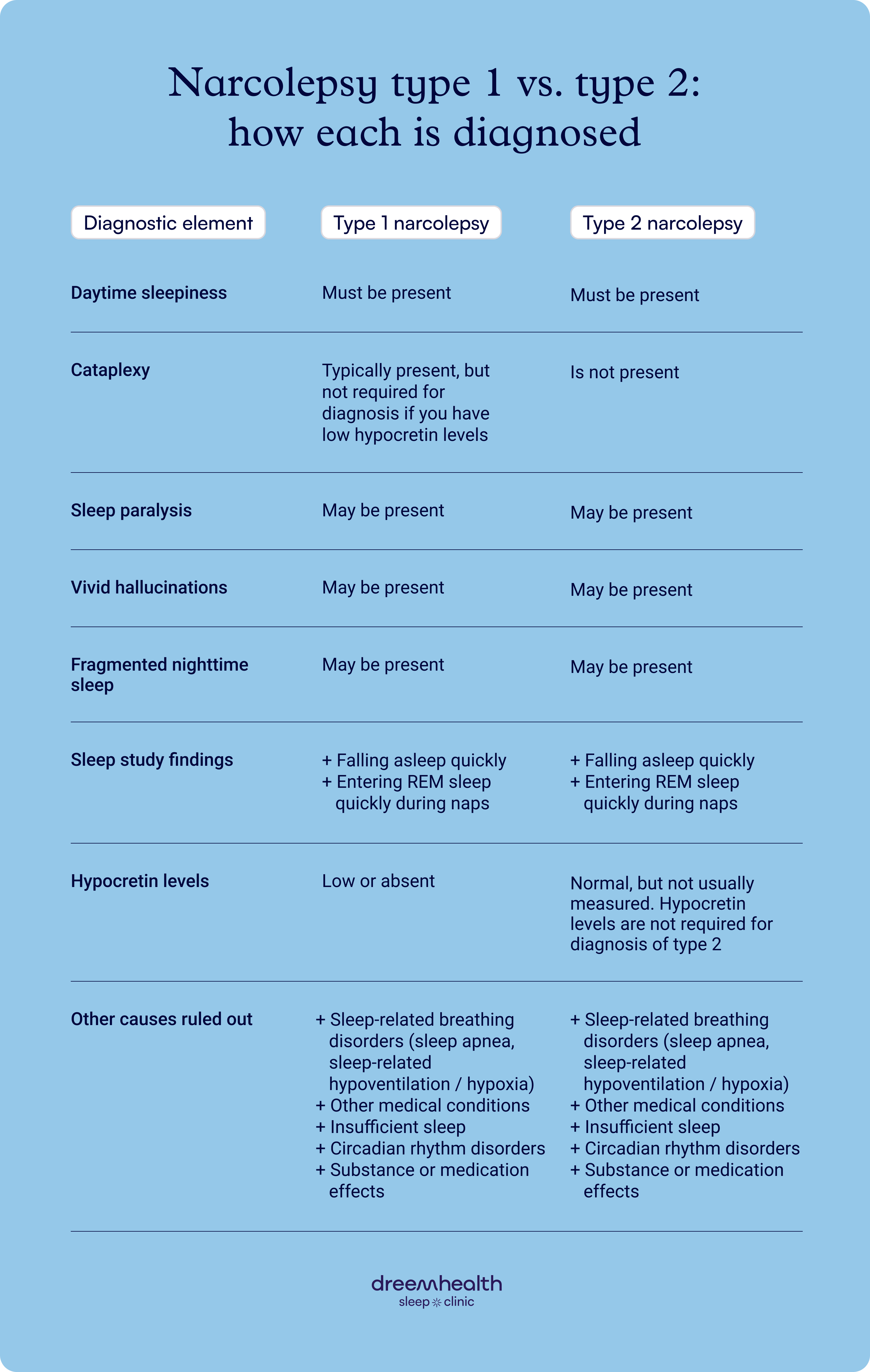
Since there are two main forms of narcolepsy, type 1 narcolepsy and type 2 narcolepsy, sometimes additional testing is necessary to diagnose the specific type. Testing may include checking levels of hypocretin, a natural chemical in your body that helps you stay awake and controls REM sleep. A physician may decide to check a patient’s hypocretin levels if their MSLT results are normal, or if the test is inconclusive.
Type 1 narcolepsy presents with excessive daytime sleepiness, cataplexy (muscle weakness triggered by strong emotions), and a hypocretin (orexin) deficiency.
Type 2 narcolepsy is characterized by excessive daytime sleepiness without cataplexy, and people with this type usually have normal hypocretin levels.
Type 1 narcolepsy can be confirmed through a lumbar puncture, where a sample of cerebrospinal fluid is collected using a thin needle into the spine. If you have low or absent hypocretin levels, you will be classified as having type 1 narcolepsy.
While type 2 narcolepsy is generally classified as having narcolepsy without cataplexy, low hypocretin levels are the ultimate difference. Even if the patient doesn’t have cataplexy, they will still be classified as having type 1 narcolepsy if their hypocretin levels are low.
What do narcolepsy test results mean?
Results that typically support a narcolepsy diagnosis include falling asleep quickly and entering REM sleep early during naps. Per a 2023 review published in Sleep Medicine, normal multiple sleep latency (the amount of time it takes you to fall asleep) is approximately 11 minutes. But an MSL of eight minutes or less may indicate narcolepsy. Your healthcare provider will also take your symptoms and medical history into account when reviewing your results to make a definitive diagnosis.
According to the National Institute of Neurological Disorders and Stroke, your PSG will determine if REM sleep occurs too early in the sleep cycle (normal range is within 60 to 90 minutes of falling asleep). The PSG will also check for (or rule out) conditions like sleep apnea.
Your MSLT, however, determines how quickly you fall asleep and whether your REM sleep cycles are disrupted.
In some cases, patients may receive inconclusive results from their sleep studies. A 2014 article in Sleep notes that diagnosing narcolepsy without the appearance of cataplexy (a common narcolepsy symptom) is often more challenging and may require additional testing. And, according to a 2021 study in Neuropsychopharmacology Reports, narcolepsy misdiagnosis is also possible if a patient begins a sleep study with chronic sleep debt (even if they get adequate sleep during the PSG).
All that to say: Though research on the benefits remain limited, your healthcare provider may recommend repeat testing, depending on your case.
What conditions can look like narcolepsy?
Many conditions share excessive daytime sleepiness as a symptom — which means accurate testing is essential to tell them apart. Below are some of the more common conditions that may resemble narcolepsy.
-
Sleep apnea: a sleep disorder where your breathing repeatedly stops and restarts throughout the night. One of its principal symptoms is excessive daytime sleepiness, the same as narcolepsy.
-
Idiopathic hypersomnia: a rare neurological sleep disorder where the cause is unknown. Symptoms overlap with narcolepsy and also include excessive daytime sleepiness.
-
Insufficient sleep syndrome: (ISS): While ISS can resemble narcolepsy through similar symptoms like excessive daytime sleepiness and brain fog, the root cause for both is quite different. ISS is generally the result of voluntary poor sleep habits, while narcolepsy is a neurological sleep disorder.
-
Epilepsy: Both narcolepsy and epilepsy — a seizure disorder — are neurological conditions that can cause people to fall over suddenly. In narcolepsy, this is usually due to cataplexy. But in epilepsy, this is due to brain seizures that may resemble cataplexy’s loss of muscle tone.
How can you get an accurate narcolepsy diagnosis sooner?
Getting a narcolepsy diagnosis can be elusive — not only does it take time, but you also may find yourself going through several providers before such a diagnosis is considered. As Ostroff can attest, it may take significant self-advocacy to reach your goal.
“The frustrating thing is, even when your doctor hears you, the first time he prescribed me the sleep study, he only tested me for sleep apnea, despite me asking to be tested for narcolepsy,” she says.
One of the best ways to get closer to an accurate narcolepsy diagnosis is to be proactive about your medical care. Below are a few practical steps that will help you prepare for your initial appointment.
-
Track your symptoms: Keep a sleep diary or use actigraphy to document your sleep habits, your sleep quality, and any lifestyle factors that may affect your sleep.
-
Enlist your bed partner and family members for their insights: Your loved ones may have noticed symptoms that you haven’t. Their observations will help your healthcare provider create a full medical profile.
-
Bring specific questions to your appointments, like:
-
Which tests do you recommend?
-
I think I may have narcolepsy: Do you think I should get an overnight PSG and an MSLT?
-
How will you rule out certain diagnoses?
-
What happens if my results are inconclusive?
-
Ask for a sleep medicine specialist or neurologist referral ASAP: Many primary care physicians cannot diagnose narcolepsy. But since narcolepsy is a neurological condition, you can receive a diagnosis not only from a sleep medicine specialist, but also from a neurologist.
If you’re ready to get answers about your excessive daytime sleepiness directly from sleep medicine experts, book an appointment for Dreem Health’s hypersomnia evaluation. Dreem Health’s sleep specialists will assess your symptoms virtually and quickly, then guide you to next steps.
The bottom line
Even though getting a narcolepsy diagnosis can feel like an arduous process, the more you know about each step can make the road to answers that much easier. Once you receive your diagnosis, multiple treatment options are available. Take that first step toward a narcolepsy diagnosis by booking an initial appointment with Dreem Health today.
Frequently asked questions (FAQs)
What are the requirements for a narcolepsy diagnosis?
The requirements for a narcolepsy diagnosis include excessive daytime sleepiness, falling asleep too quickly, and entering rapid-eye movement (REM) sleep too early in a sleep cycle. A sleep medicine specialist will also take your symptoms and medical history into account when making a diagnosis.
Can narcolepsy be diagnosed without a sleep study?
No, type 2 narcolepsy cannot be diagnosed without a sleep study. According to the American Academy of Sleep Medicine guidelines, a diagnosis usually requires a medical history, physical examination, and two sleep studies: overnight polysomnography and a daytime sleep latency test.
How long does it take to get a narcolepsy diagnosis?
A delayed narcolepsy diagnosis is, unfortunately, quite common. Some studies say it can take up to 15 years to obtain a diagnosis, with misdiagnosis and lack of symptom recognition often explaining such long delays.
Does sleep paralysis mean you have narcolepsy?
Maybe. Sleep paralysis is a common symptom of narcolepsy, but if you are not experiencing recurring sleep paralysis, or other narcolepsy symptoms like excessive daytime sleepiness or cataplexy, the root cause may be something else.
Abramovici, S., & Bagić, A. (2016). Epidemiology of epilepsy. In M. J. Aminoff, F. Boller, & D. F. Swaab (Eds.), Handbook of clinical neurology (Vol. 138, pp. 159–171). Elsevier. https://doi.org/10.1016/B978-0-12-802973-2.00010-0
American Academy of Sleep Medicine. (n.d.). Narcolepsy provider fact sheet. https://aasm.org/wp-content/uploads/2022/07/ProviderFS-Narcolepsy.pdf
American Academy of Sleep Medicine. (2025, November 17). Daytime sleepiness affects daily activities of most adults. https://aasm.org/daytime-sleepiness-affects-daily-activities-of-most-adults/
American Academy of Sleep Medicine Sleep Education. (2020a, August). Narcolepsy. https://sleepeducation.org/sleep-disorders/narcolepsy/
American Academy of Sleep Medicine Sleep Education. (2020b, September). Sleep study. https://sleepeducation.org/patients/sleep-study/
American Academy of Sleep Medicine Sleep Education. (2020c, September). Multiple sleep latency test. https://sleepeducation.org/patients/multiple-sleep-latency-test/
American Academy of Sleep Medicine Sleep Education. (2020d, December). Insufficient sleep syndrome. https://sleepeducation.org/sleep-disorders/insufficient-sleep-syndrome/
American Academy of Sleep Medicine Sleep Education. (2024, March). What to expect at a sleep study. https://sleepeducation.org/what-to-expect-at-your-sleep-study/
Andlauer, O., Moore, H., Jouhier, L., Drake, C., Peppard, P. E., Han, F., Hong, S. C., Poli, F., Plazzi, G., O’Hara, R., Haffen, E., Roth, T., Young, T., & Mignot, E. (2013). Nocturnal rapid eye movement sleep latency for identifying patients with narcolepsy/hypocretin deficiency. JAMA Neurology, 70(7), 891–902. https://doi.org/10.1001/jamaneurol.2013.1589
Arand, D. L., & Bonnet, M. H. (2019). The multiple sleep latency test. Handbook of Clinical Neurology, 160, 393–403. https://doi.org/10.1016/B978-0-444-64032-1.00026-6
Baumann, C., Mignot, E., Lammers, G., Overeem, S., Arnulf, I., Rye, D., Dauvilliers, Y., Honda, M., Owens, J., Plazzi, G., & Scammell, T. (2014). Challenges in diagnosing narcolepsy without cataplexy: A consensus statement. Sleep, 37(6), 1035–1042. https://doi.org/10.5665/sleep.3756
Berger, A., Wielgus, K., Young-McCaughan, S., Fischer, P., Farr, L., & Lee, K. (2008). Methodological challenges when using actigraphy in research. Journal of Pain and Symptom Management, 36(2), 191–199. https://doi.org/10.1016/j.jpainsymman.2007.10.008
Bhalerao, V., Gotarkar, S., Vishwakarma, D., & Kanchan, S. (2024). Recent insights into sleep paralysis: Mechanisms and management. Cureus, 16(7), Article e65413. https://doi.org/10.7759/cureus.65413
Blattner, M., & Maski, K. (2023). Narcolepsy and idiopathic hypersomnia. Sleep Medicine Clinics, 18(2), 183–199. https://doi.org/10.1016/j.jsmc.2023.01.003
Blattner, M., & Scammell, T. (2024). What is cataplexy? Sleep, 47(11), Article zsad261. https://doi.org/10.1093/sleep/zsad261
Blumberg, M. S., Lesku, J. A., Libourel, P. A., Schmidt, M. H., & Rattenborg, N. C. (2020). What is REM sleep? Current Biology, 30(1), R38–R49. https://doi.org/10.1016/j.cub.2019.11.045
Boulanger, T., Pigeon, P., & Crawford, S. (2024). Diagnostic challenges and burden of idiopathic hypersomnia: A systematic literature review. Sleep Advances, 5(1), Article zpae059. https://doi.org/10.1093/sleepadvances/zpae059
Bourgin, P., Zeitzer, J. M., & Mignot, E. (2008). CSF hypocretin-1 assessment in sleep and neurological disorders. The Lancet Neurology, 7(7), 649–662. https://doi.org/10.1016/S1474-4422(08)70140-6
Carter, L., Acebo, C., & Kim, A. (2013). Patients’ journeys to a narcolepsy diagnosis. Sleep Medicine, 14(Suppl. 1), e92. https://doi.org/10.1016/j.sleep.2013.11.193
Chavda, V., Chaurasia, B., Umana, G. E., Tomasi, S. O., Lu, B., & Montemurro, N. (2022). Narcolepsy—A neuropathological obscure sleep disorder: A narrative review of current literature. Brain Sciences, 12(11), Article 1473. https://doi.org/10.3390/brainsci12111473
Coelho, F. M., Georgsson, H., & Murray, B. J. (2011). Benefit of repeat multiple sleep latency testing in confirming a possible narcolepsy diagnosis. Journal of Clinical Neurophysiology, 28(4), 412–414. https://doi.org/10.1097/WNP.0b013e31822734a3
Epworth sleepiness scale. (n.d.). Centers for Disease Control and Prevention. https://www.cdc.gov/niosh/work-hour-training-for-nurses/longhours/mod2/epworth-P.pdf
Golden, E., & Lipford, M. (2018). Narcolepsy: Diagnosis and management. Cleveland Clinic Journal of Medicine, 85(12), 959–969. https://doi.org/10.3949/ccjm.85a.17086
Hanin, C., Arnulf, I., Maranci, J. B., Lecendreux, M., Levinson, D. F., Cohen, D., & Laurent-Levinson, C. (2021). Narcolepsy and psychosis: A systematic review. Acta Psychiatrica Scandinavica, 144(1), 28–41. https://doi.org/10.1111/acps.13300
Hastings, N. E., Abdi, K. E., Bibi, F., Aslam, B., Nuñez, M. R., Sherani, M. T. R., Shadmani, S., Alam, U., Hassan, V. M., Hoor-E-Ainaa, Imran, H., Hanna, J., & Sadat, S. H. (2025). Narcolepsy: Pathophysiology, diagnosis, management, and future directions, a narrative review. Brain and Behavior, 15(12), Article e71116. https://doi.org/10.1002/brb3.71116
Iskander, A., Jairam, T., Wang, C., Murray, B., & Boulos, M. (2023). Normal multiple sleep latency test values in adults: A systematic review and meta-analysis. Sleep Medicine, 109, 143–148. https://doi.org/10.1016/j.sleep.2023.06.019
Johns Hopkins Medicine. (n.d.). Electroencephalogram (EEG). https://www.hopkinsmedicine.org/health/treatment-tests-and-therapies/electroencephalogram-eeg
Jung, Y., Ji, K., Kim, D., Kim, K., Choi, Y., Cho, J., Kim, H., Lee, W., Sunwoo, J., Koo, D., Im, H., & Yang, K. (2025). Factors associated with diagnostic delay in narcolepsy: Real-world data from a Korean multicenter study. Sleep Medicine, 133, Article 106646. https://doi.org/10.1016/j.sleep.2025.106646
Kizawa, T., Hosokawa, K., Nishijima, T., Takahashi, S., Shimizu, T., Ono, T., Han, G., Kanbayashi, T., Sakurai, S., & Kondo, H. (2021). False-positive cases in multiple sleep latency test by accumulated sleep debt. Neuropsychopharmacology Reports, 41(2), 192–198. https://doi.org/10.1002/npr2.12169
Krahn, L. E., Arand, D. L., Avidan, A. Y., Davila, D. G., DeBassio, W. A., Ruoff, C. M., & Harrod, C. G. (2021). Recommended protocols for the multiple sleep latency test and maintenance of wakefulness test in adults: Guidance from the American Academy of Sleep Medicine. Journal of Clinical Sleep Medicine, 17(12), 2489–2498. https://doi.org/10.5664/jcsm.9620
Lal, C., Weaver, T. E., Bae, C. J., & Strohl, K. P. (2021). Excessive daytime sleepiness in obstructive sleep apnea: Mechanisms and clinical management. Annals of the American Thoracic Society, 18(5), 757–768. https://doi.org/10.1513/AnnalsATS.202006-696FR
Manconi, M., Castelnovo, A., Miano, S., & De Pieri, M. (2026). Clinical and instrumental comparison between insufficient sleep syndrome and narcolepsy type 1. Sleep Medicine, 138, Article 108720. https://doi.org/10.1016/j.sleep.2025.108720
Morse, A. M. (2019). Narcolepsy in children and adults: A guide to improved recognition, diagnosis and management. Medical Sciences, 7(12), Article 106. https://doi.org/10.3390/medsci7120106
National Cancer Institute. (2020). Lumbar puncture. In NCI dictionary of cancer terms. https://www.cancer.gov/publications/dictionaries/cancer-terms/def/lumbar-puncture
National Heart, Lung, and Blood Institute. (2019, January). Sleep diary. https://www.nhlbi.nih.gov/resources/sleep-diary
National Institute of Neurological Disorders and Stroke. (n.d.). Narcolepsy. https://www.ninds.nih.gov/health-information/disorders/narcolepsy
Patel, S., Kon, S. S. C., Nolan, C. M., Barker, R. E., Simonds, A. K., Morrell, M. J., & Man, W. D. (2018). The Epworth Sleepiness Scale: Minimum clinically important difference in obstructive sleep apnea. American Journal of Respiratory and Critical Care Medicine, 197(7), 961–963. https://doi.org/10.1164/rccm.201704-0672LE
Rehim, E. D., & Vendrame, M. (2024). Cataplexy mistaken for seizures in a patient with undiagnosed narcolepsy type I. Cureus, 16(4), Article e57540. https://doi.org/10.7759/cureus.57540
Ren, J., Zhao, X., Su, C., Li, X., & Zhou, J. (2024). ADHD in narcolepsy: A closer look at prevalence and ties. Neuroscience & Biobehavioral Reviews, 156, Article 105471. https://doi.org/10.1016/j.neubiorev.2023.105471
Rosenberg, R., Hirshkowitz, M., Rapoport, D., & Kryger, M. (2019). The role of home sleep testing for evaluation of patients with excessive daytime sleepiness: Focus on obstructive sleep apnea and narcolepsy. Sleep Medicine, 56, 80–89. https://doi.org/10.1016/j.sleep.2019.01.014
Roth, T., Dauvilliers, Y., Mignot, E., Montplaisir, J., Paul, J., Swick, T., & Zee, P. (2013). Disrupted nighttime sleep in narcolepsy. Journal of Clinical Sleep Medicine, 9(9), 955–965. https://doi.org/10.5664/jcsm.3004
Rundo, J. V., & Downey, R., III. (2019). Polysomnography. Handbook of Clinical Neurology, 160, 381–392. https://doi.org/10.1016/B978-0-444-64032-1.00025-4
Sangal, R. B., Mitler, M. M., & Sangal, J. M. (1999). Subjective sleepiness ratings (Epworth Sleepiness Scale) do not reflect the same parameter of sleepiness as objective sleepiness (maintenance of wakefulness test) in patients with narcolepsy. Clinical Neurophysiology, 110(12), 2131–2135. https://doi.org/10.1016/S1388-2457(99)00167-4
Thorpy, M. J., & Krieger, A. C. (2014). Delayed diagnosis of narcolepsy: Characterization and impact. Sleep Medicine, 15(5), 502–507. https://doi.org/10.1016/j.sleep.2014.01.015
Wilenius, L., & Partinen, M. (2020). Attention-deficit/hyperactivity disorder patients may have undiagnosed narcolepsy. Cureus, 12(6), Article e8436. https://doi.org/10.7759/cureus.8436